SymOrg 2026 Concludes: Trust, Artificial Intelligence, and Future Competencies Take Center Stage at the Anniversary Edition
The third and final day of the International Symposium on Organizational Sciences SymOrg 2026 was marked by discussions on key issues shaping contemporary society and business, including the role of artificial intelligence, the importance of building trust within organizations, and the development of competencies necessary to address future labor market challenges. This successfully concluded with the 20th anniversary edition of SymOrg, one of the leading international scientific conferences in the field of organizational sciences.
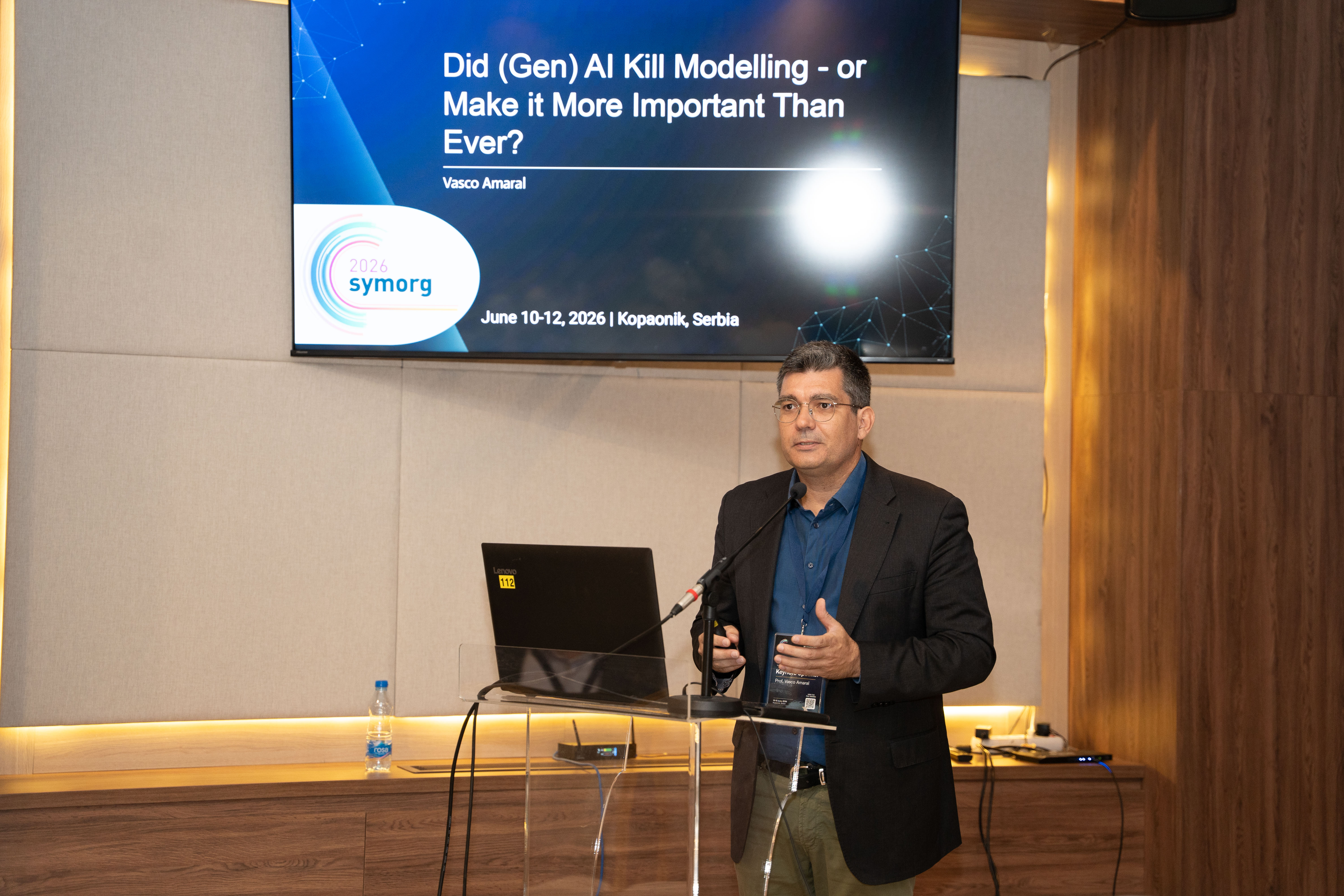
The final day of the symposium opened with keynote addresses by distinguished international speakers Prof. Vasco Amaral, Associate Professor at NOVA School of Science and Technology and Vice President of the International Federation for Information Processing (IFIP), and Dr. Ulrich Harmes-Liedtke, Founder of Mesopartner.
In his lecture, “Did AI Kill Modeling – or Make it More Important Than Ever?”, Prof. Amaral discussed the role of system modeling in the era of generative artificial intelligence. He emphasized that the ability to understand, model, and control complex systems remains one of the most important tasks of modern software engineering, highlighting that artificial intelligence can be a powerful ally for engineers, but not a substitute for expertise and critical thinking.
Dr. Ulrich Harmes-Liedtke delivered the lecture “The Architecture of Trust: Quality Infrastructure and the Resilient Organization”, focusing on the role of trust, standards, and compliance systems in building resilient organizations. Discussing quality infrastructure, which encompasses standardization, accreditation, certification, metrology, and conformity assessment, he stressed that these mechanisms form the foundation of competitiveness and sustainable organizational development in today’s global environment.
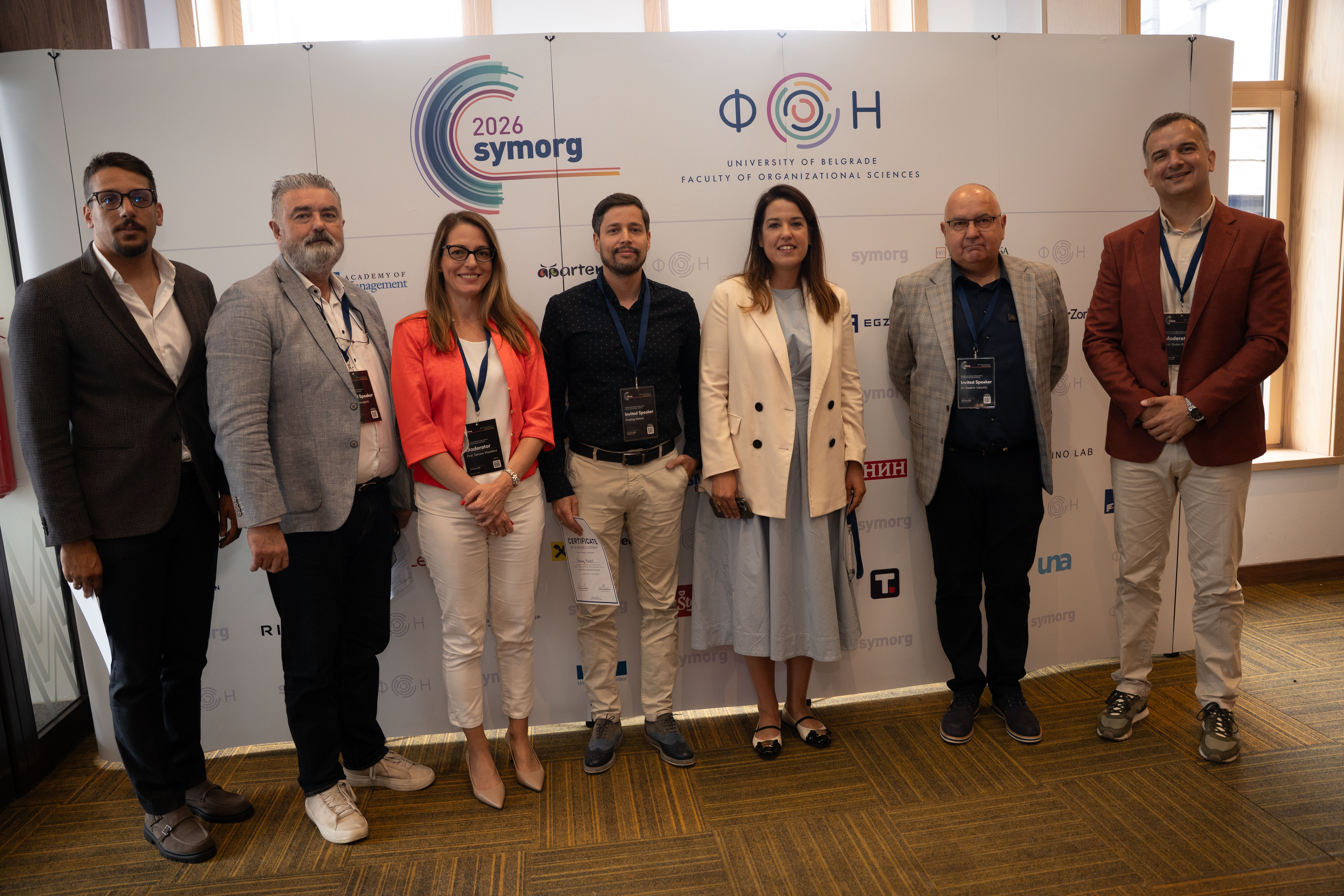
Following the keynote presentations, the panel discussion “AI that Delivers: Turning Disruption into Advantage” was held, moderated by Prof. Dušan Barać, Vice Dean of the Faculty of Organizational Sciences, and Prof. Tamara Vlastelica. The discussion addressed the application of artificial intelligence in business, finance, public administration, and cybersecurity.
The panel featured Vladan Atanasijević, CEO of Egzakta, Predrag Maletić, Head of AI Products at Raiffeisen Bank, Dr. Vladimir Udovičić, Research Advisor and Acting Director of the Institute for Artificial Intelligence of Serbia, Sanja Bakoč, Consulting Director and Public Sector Leader for Serbia, Montenegro, and Bosnia and Herzegovina at Ernst & Young (EY), and Andrej Stojić, Sales Director at Oktacron.
Discussing the challenges of AI implementation within organizations, Sanja Bakoč emphasized the importance of continuously developing employee competencies and ensuring the responsible use of emerging technologies.
“We must remain cautious. If artificial intelligence were used entirely without human oversight and support, it would lead to collapse,” Bakoč noted, citing examples from international practice.
Vladan Atanasijević highlighted that artificial intelligence has become an unavoidable part of business reality and that its greatest value in the coming years will lie in improving organizational productivity and efficiency.
“Artificial intelligence is here, and no one can ignore it. However, if organizations have not invested in quality data and processes over the past years, AI cannot solve existing problems—it can only accelerate what has already been properly established,” Atanasijević emphasized.
From the perspective of the financial sector, Predrag Maletić pointed out that the greatest challenges are no longer technological, but organizational in nature.
“We see the highest return on investment in the application of large language models where manual work can be reduced. The key question today is not what technology can do, but how we can equip people to use it responsibly,” said Maletić.
Addressing the role of artificial intelligence in cybersecurity, Andrej Stojić stressed that no organization can guarantee absolute data security, but that the proper use of AI tools can significantly contribute to prevention and faster responses to security incidents.
Dr. Vladimir Udovičić provided additional insights into the development of Serbia’s AI ecosystem, presenting the experiences of the Institute for Artificial Intelligence of Serbia and emphasizing the importance of aligning research activities with the needs of industry and the public sector.
A key takeaway from the panel was that artificial intelligence should serve as a tool for empowering people and organizations rather than replacing expertise, experience, and critical thinking.
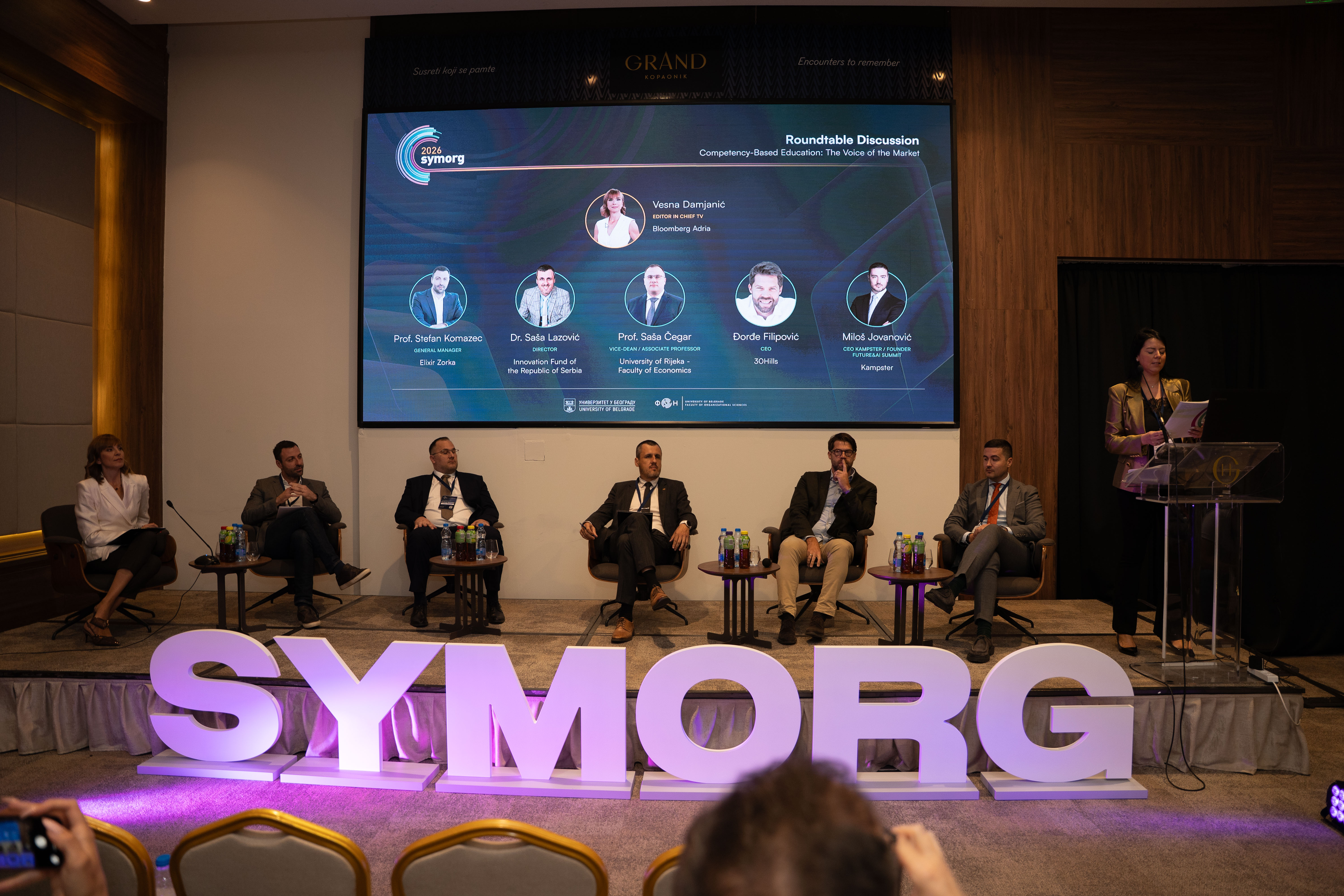
In addition to the AI-focused panel, the roundtable “Competency-Based Education: The Voice of the Market” was held and moderated by Vesna Damjanić, Editor-in-Chief of Bloomberg Adria.
Participants included Prof. Stefan Komazec, General Manager of Elixir Zorka, Dr. Saša Lazović, Director of the Innovation Fund of the Republic of Serbia, Prof. Saša Čegar, Vice Dean of the Faculty of Economics and Business at the University of Rijeka, Đorđe Filipović, CEO of 30Hills, and Miloš Jovanović, Founder of Kampster and the Future & AI Summit.
Speaking about the need for stronger collaboration between education and industry, Prof. Komazec emphasized that companies today seek individuals who are willing to learn, take initiative, and adapt quickly to change.
Prof. Čegar highlighted critical thinking as one of the most important competencies of the future, while Dr. Lazović stressed the need for a better understanding of the social implications of technological change and its impact on the labor market.
Discussing entrepreneurship, Đorđe Filipović noted that an entrepreneurial mindset is developed through practice, experience, and a willingness to take responsibility, while Miloš Jovanović argued that Serbia should not merely follow global trends but actively seek opportunities to help shape them.
The discussion demonstrated that competitiveness in the age of artificial intelligence will depend not only on technical knowledge but, above all, on individuals’ ability to learn, collaborate, take initiative, and adapt to change. Participants agreed that developing such competencies requires stronger cooperation between universities, industry, and the innovation ecosystem.
Closing the roundtable, moderator Vesna Damjanić emphasized that one of the key messages of the discussion was the need for continuous dialogue between academia, industry, and the innovation community.
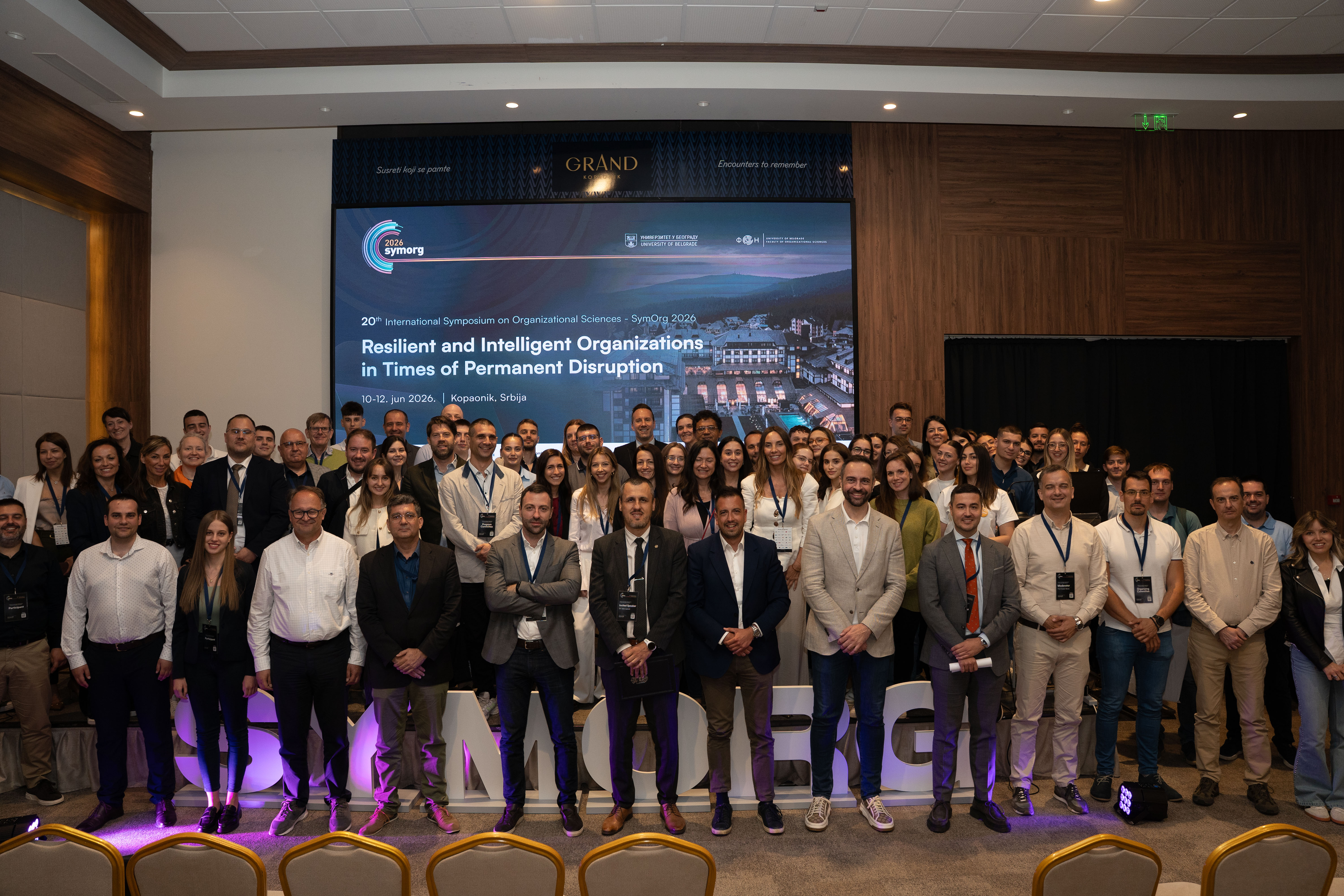
The conclusion of the program marked the end of SymOrg 2026, which brought together more than 300 participants from 22 countries over three days. The scientific program featured 138 papers authored by 352 researchers addressing current challenges in organizational sciences, management, digital transformation, and innovation, while the conference was further enriched by 25 distinguished speakers from Serbia and abroad.
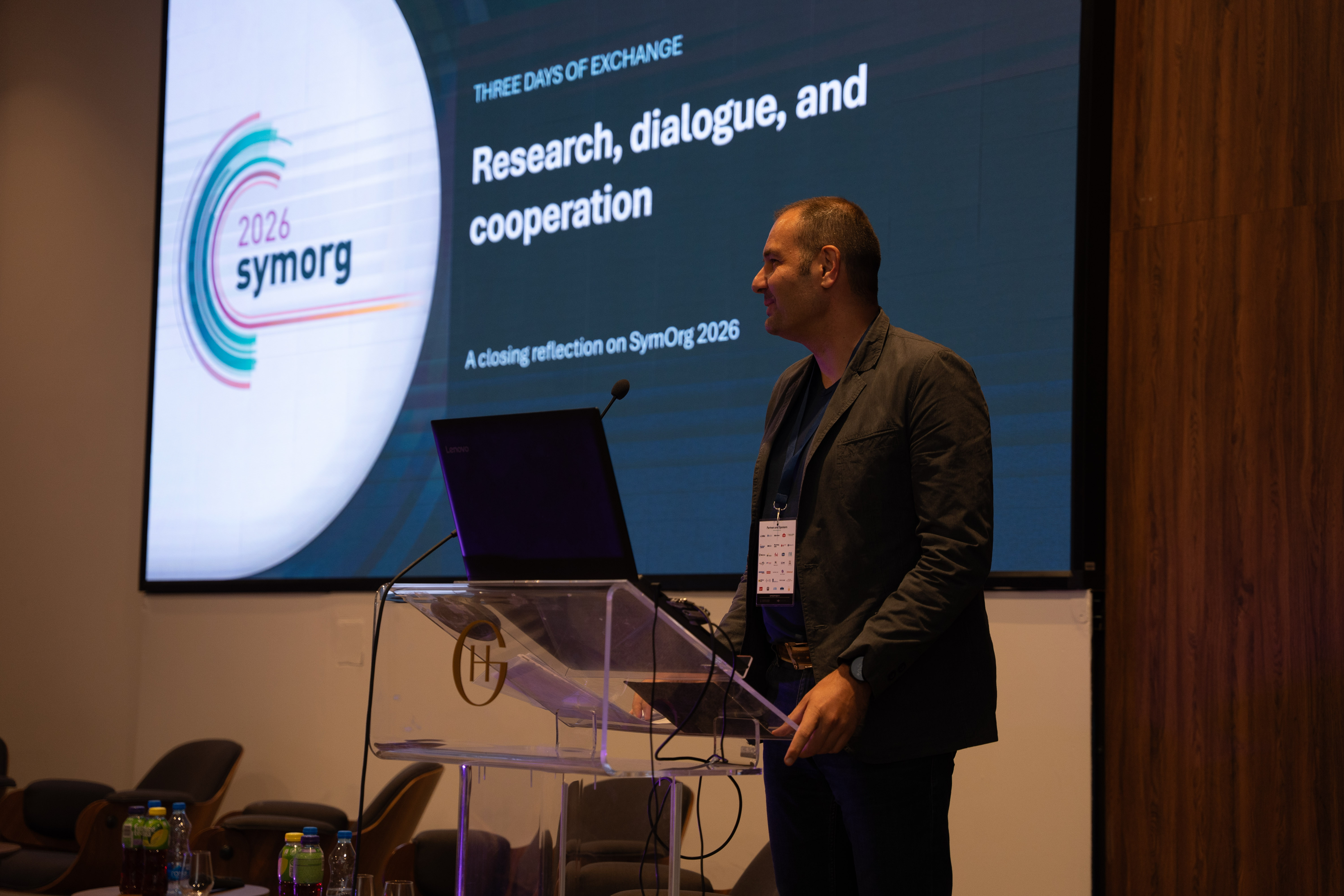
At the closing ceremony, Prof. Boris Delibašić, Vice Dean and Chair of the Conference Program Committee, thanked participants, partners, and the organizing team for their contributions to the success of the conference, emphasizing that international collaboration and interdisciplinary approaches remain essential for understanding organizations and society in times of rapid change.
As is tradition, the closing ceremony also included awards for outstanding scientific contributions. The Best Paper Award was presented to “Examining the Visual Attention Performance of Online Channels: A Comparison of Implicit and Explicit Methods on a Website in the Cosmetic Industry”, authored by Elli Vasiliki Papadopoulou, Nikolaos Dimitriadis, and Marko Ćirović.
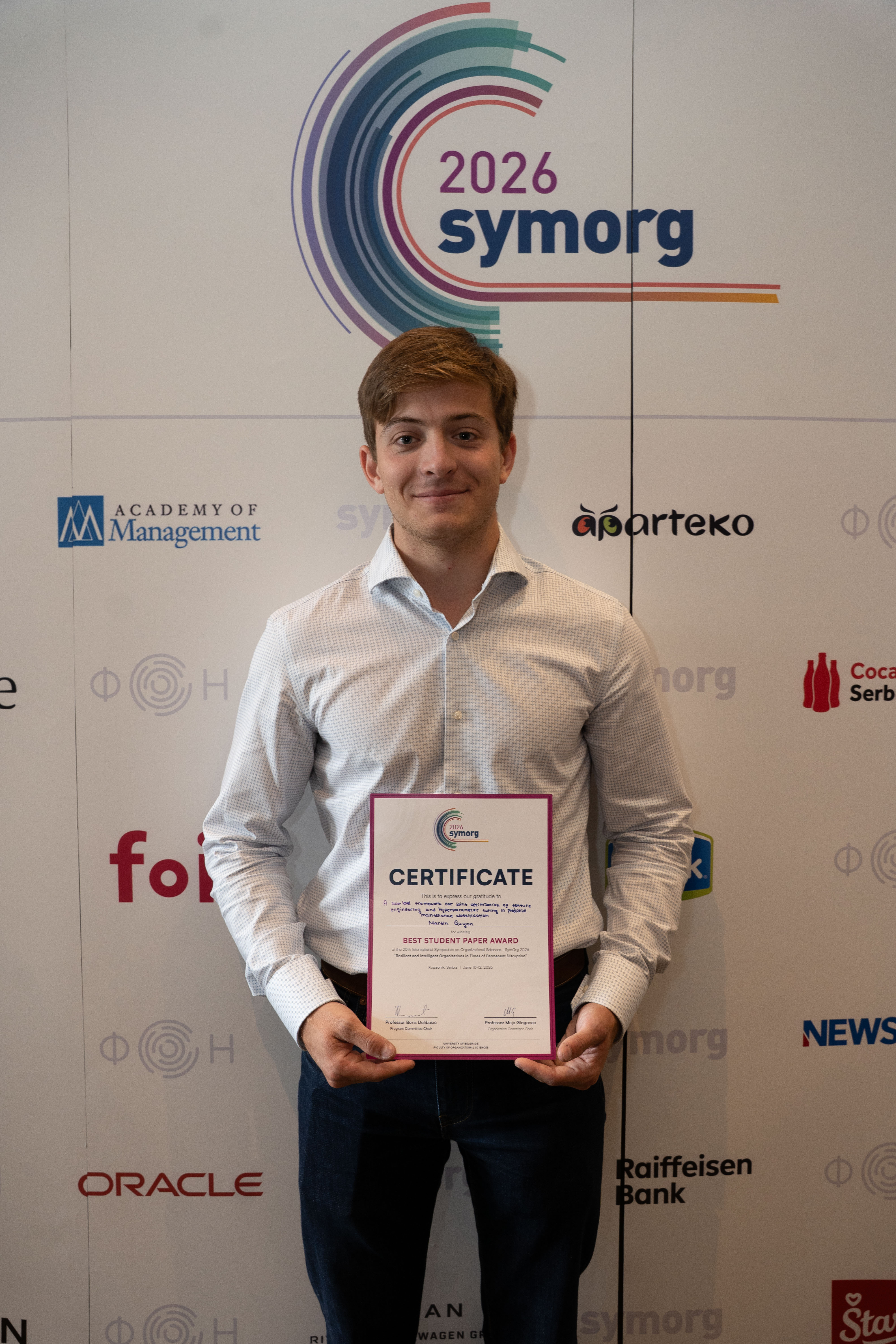
The Best Young Researcher Paper Award was presented to Martin Guyon of ISAE-SUPAERO, France, for the paper “A Two-Level Framework for Joint Optimization of Feature Engineering and Hyperparameter Tuning in Predictive Maintenance Classification.”
The Best Presentation Award was presented to the paper “Revenue Optimization of New York City Taxi Services Using Linear Programming and Metaheuristics”, authored by Isidora Gaćeša and Gordana Savić from the Faculty of Organizational Sciences, University of Belgrade, and Violeta Cvetkoska from Ss. Cyril and Methodius University in Skopje.
Through the awards ceremony and the official closing of the symposium, SymOrg once again reaffirmed its role as an international platform for knowledge exchange, collaboration between academia, industry, and policymakers, and dialogue on the issues shaping the future of organizations and society. The 20th anniversary edition demonstrated that trust, the responsible use of artificial intelligence, and the development of future competencies are among the key prerequisites for sustainable development in an era of rapid change.
Photo Gallery

Latest News
View AllSymOrg 2026 Concludes: Trust, Artificial Intelligence, and Future Competencies Take Center Stage at the Anniversary Edition
The third and final day of the International Symposium on Organizational Sciences SymOrg 2026 was marked by discussions on key issues shaping contemporary society and business, including the role of artificial intelligence, the importance of building trust within organizations, and the development of competencies necessary to address future labor market challenges. This successfully concluded with the 20th anniversary edition of SymOrg, one of the leading international scientific conferences in the field of organizational sciences.
From Science to Innovation: Day Two of SymOrg 2026 Brings Together Academia, Industry, and the Startup Community
The second day of SymOrg 2026 brought together thematic and poster sessions, the Business Forum, Startup Presentations, and the Students Startup Achievement session.
SymOrg 2026 Opens: Twentieth Edition of the Leading International Symposium on Organizational Sciences Brings Together the Global Academic Elite
The Faculty of Organizational Sciences, University of Belgrade, has officially opened the 20th International Symposium on Organizational Sciences - SymOrg 2026.